Every product manager knows the rush of a successful launch. The feature is live in production, the deployment went smoothly, and your work is available to customers. Champagne corks pop. Congratulations flow in Slack. The team celebrates hitting the deadline.
But here’s the uncomfortable truth: you haven’t accomplished anything yet.
The 7 Minutes of Terror
NASA’s Mars rover missions include a phase engineers call the “7 minutes of terror“—the time between when the spacecraft enters Mars’ atmosphere and when it should touch down on the surface. During those 7 minutes, the rover is completely autonomous. Radio signals take 14 minutes to travel between Mars and Earth, so there’s no way to course-correct if something goes wrong. Mission Control can only watch, wait, and hope.
Think about that for a moment. NASA spent years planning, billions of dollars building, and months traveling 300 million miles through space—but none of that matters if those 7 minutes fail. Launching the rocket from Earth was merely the beginning. The goal was never to launch. The goal was to land.
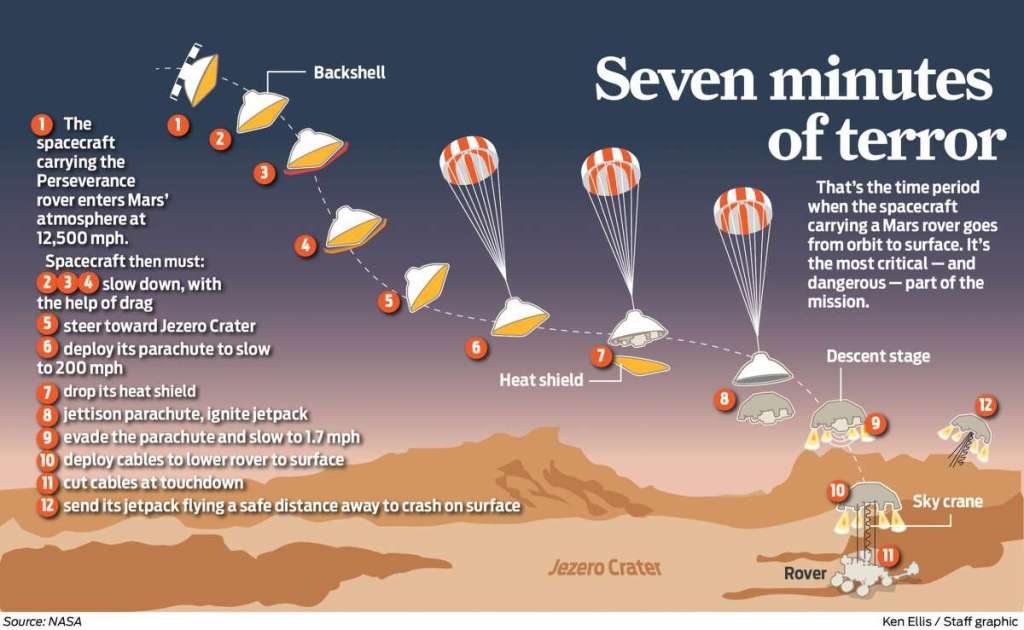
As product managers, we have our own 7 minutes of terror. It starts the moment we ship and ends only when our customers—and our business—begin realizing value. This is when we discover whether our product will actually land or crater into the Martian surface.
Launching Isn’t Landing
Think of it this way: launching means your product is technically available. Landing means your customers are successfully using it to achieve their goals.
Imagine a fictitious developer tool company—let’s call them “FiveNode”—that builds a new automated code review assistant. They spend months building the feature, integrating it with popular version control systems, training the AI models, and perfecting the algorithms. Launch day arrives, they flip the switch, and the feature is live.
Launch successful!
But then reality hits. Adoption is at 2%. The few developers who try it find the suggestions too noisy. Teams don’t trust the automated feedback. The feature sits there, technically working perfectly, but creating zero value. FiveNode launched their code review assistant, but they never landed it.
Now contrast that with another fictitious company—”SevenStack”—launching a similar feature. They also get their automated code reviewer into production. But SevenStack’s product manager doesn’t celebrate yet. Instead, she watches the telemetry obsessively. She notices developers are confused about how to configure the sensitivity settings. Within 48 hours, the team ships a simplified onboarding flow. They see teams ignoring certain types of suggestions, so they adjust the defaults. A week later, adoption is climbing, developers are accepting 60% of suggestions, and code review cycle time has dropped by 30%.
SevenStack didn’t just launch. They landed.
The Beagle 2 Lesson
In 2003, the European Space Agency launched Beagle 2, a Mars lander designed to search for signs of life. On Christmas Day 2003, Beagle 2 was scheduled to land on Mars and phone home.
Silence.
Days passed. Then weeks. Mission Control tried repeatedly to establish contact. Nothing. After months of silence, they declared Beagle 2 lost—a complete failure despite a successful launch.
Here’s the twist: Beagle 2 actually landed successfully on Mars.
Eleven years later, in 2014, NASA’s Mars Reconnaissance Orbiter spotted Beagle 2 on the surface. The landing was perfect. But one of its solar panels failed to fully deploy, blocking the antenna. Beagle 2 sat on Mars, potentially collecting valuable scientific data, but unable to transmit anything back to Earth.
It launched. It landed. But because the team couldn’t confirm it was working, and because it couldn’t send data back home, it was functionally useless.
Sound familiar?
How many features have you shipped that landed in production but failed to “deploy their solar panels”? Maybe customers couldn’t find them. Maybe the onboarding was too complex. Maybe they solved a problem nobody actually had. The feature was there, working perfectly from a technical standpoint, but creating zero value.
Without telemetry—without the ability to measure whether your product is actually working for customers—you’re flying blind.
Telemetry Is Your Lifeline
NASA’s rovers send back detailed telemetry: temperature readings, battery levels, soil composition, images, location data. This constant stream of information proves the rover landed successfully and is accomplishing its mission.
Your product needs the same thing.
Let’s return to FiveNode. Having learned from their code review assistant failure, they’re now launching a new debugging visualization tool. This time, they don’t just know it shipped—they’ve instrumented comprehensive telemetry that reveals:
- Only 15% of developers who see the feature actually try it (adoption problem)
- Of those who try it, 80% abandon it within the first session (onboarding problem)
- The 20% who persist use it heavily and rave about it (product-market fit with a subset)
- Teams using it reduce debugging time by 25% (clear value creation)
- But most teams never get past the initial learning curve (landing failure)
This telemetry tells the complete story. The feature launched successfully and even has real value for those who master it. But it’s not landing—most customers never realize that value because the “solar panels” (in this case, intuitive onboarding) never fully deployed.
Customer telemetry you need:
- Are users actually adopting the feature?
- How are they using it (vs. how you expected)?
- Where do they get stuck or drop off?
- Are they achieving their intended outcomes?
Business telemetry you need:
- Is this driving the metrics that matter?
- Are we seeing the ROI we projected?
- What’s the actual vs. expected impact?
Done Is When Customers Win Autonomously
In product management, “done” doesn’t mean when the feature ships. Done isn’t when it’s in production. Done isn’t even when the first customer uses it.
Done is when customers autonomously realize value from what you’ve built.
“Autonomously” is the key word. If your customer success team needs to manually onboard every user, you haven’t landed. If adoption requires heroic efforts from your team, you haven’t landed. If customers need you to explain the value, you haven’t landed.
Think of it like a successful Mars rover: after it lands, it operates independently, sending back valuable data without constant human intervention. Your product should do the same—creating value for customers without requiring your team to manually operate it.
Consider our fictitious company “SevenFlow.” They launch a new performance monitoring dashboard for developers. In the first version, customers needed extensive training to interpret the metrics. The customer success team spent hours with each new account explaining how to read the data and configure alerts. They had launched, but not landed.
So they iterated. They added contextual tooltips. They created smart defaults based on application type. They built an interactive tutorial that appeared for new users. They added natural language explanations of complex metrics. Three months later, new teams were getting value within their first day, with zero human intervention required.
That’s when SevenFlow knew they had landed.
Your Landing Checklist
Here’s how to ensure you land, not just launch:
Before you launch:
- Define what “landing” means (specific, measurable outcomes)
- Instrument comprehensive telemetry
- Plan your post-launch observation period
- Identify your success metrics and leading indicators
- Prepare your course-correction playbook
During your “7 minutes of terror”:
- Monitor adoption rates obsessively
- Talk to early users immediately
- Track customer outcomes, not just usage
- Measure business impact in real-time
- Be ready to iterate quickly
After you land:
- Confirm customers are realizing value autonomously
- Validate business impact matches projections
- Document what worked (and what didn’t)
- Share learnings with the broader team
The Launch Party Can Wait
Next time your team wants to celebrate shipping a feature, pause. Remind them that you’ve only launched—you haven’t landed yet. The champagne can wait for the real victory: when your customers are winning and your business impact is measurable.
Because in the end, nobody remembers the teams that just launched products. They remember the teams that landed them.
What’s your team’s “7 minutes of terror”? How do you ensure your products land, not just launch? I’d love to hear your thoughts.




 Doug Seven
Leave a comment